Why a Little Bit of Spooky Can Be Good for Kids: Exploring Big Feelings Through Music
There is something wonderfully funny about watching a room full of children decide what "spooky" sounds like.
Someone will inevitably make a very dramatic ghost noise. Another child will stomp across the room like a monster who apparently weighs approximately four thousand pounds. Someone else discovers that a slow tap on a drum sounds mysterious and immediately becomes responsible for the soundtrack to our imaginary haunted house.
Before long, we're surrounded by whispers, BOOMS, rattles, giggles, tiptoeing feet, and some of the least frightening monsters you have ever seen.
On the surface, we're simply having fun with music.
But something much more interesting is happening underneath all those ghost noises.
Children are experimenting with emotion.
October gives us a wonderful excuse to explore sounds that feel mysterious, surprising, silly, suspenseful, and even a tiny bit scary. Through music, children can experience those feelings in a playful space where they are free to investigate them, change them, and discover that even a scary sound can become something completely different.
Sometimes, all it takes is a tambourine.
What Does "Spooky" Actually Sound Like?
Ask a child what a pumpkin looks like and you'll probably get an answer pretty quickly.
Ask them what spooky sounds like, and suddenly things become much more interesting.
Is it loud?
Is it quiet?
Does it move quickly or slowly?
Does a monster stomp or sneak?
Would a ghost play the drum, the guitar, or perhaps just float around shaking a maraca?
These questions invite children to connect sounds with feelings and ideas. A slow drumbeat might make us feel suspense. A sudden cymbal crash might surprise us. A gentle shaker could sound like leaves rustling outside a window.
Then we can start changing things.
What happens if our scary monster starts dancing?
What if the mysterious drumbeat suddenly becomes fast and silly?
What if the ghost sings instead of saying "Boooooo"?
Now children are not simply reacting to an emotion. They are playing with it.
And that is where music becomes such an interesting tool for exploring feelings.
Big Feelings Do Not Always Need Big Words
Young children experience enormous emotions long before they have the vocabulary to explain all of them.
Sometimes "I'm scared" is easy to say.
Other times, a child simply knows that something feels strange, exciting, uncomfortable, surprising, or overwhelming.
Music gives those feelings another language.
A child can pound a drum when something feels BIG.
They can play a shaker softly when they want to create something mysterious.
They can move slowly when the music feels uncertain and jump around when it suddenly changes.
There is no pressure to explain exactly what is happening.
The sound does some of the talking.
This is one of the things I love most about making music with children. Instruments give them another way to communicate before they necessarily have all the words they need.
A Little Pretend Fear Can Build Real Confidence
Children love pretending.
They become dinosaurs, superheroes, lions, princesses, astronauts, and occasionally creatures that appear to have been invented approximately thirty seconds ago.
Pretend play allows them to step into experiences while still knowing they are safe.
Music can do the same thing with emotions.
When we create a mysterious song together, children know there is not actually a monster hiding behind the drum. They can experiment with that little flutter of suspense while remaining completely in control of the experience.
We can make the music louder.
We can make it softer.
We can stop.
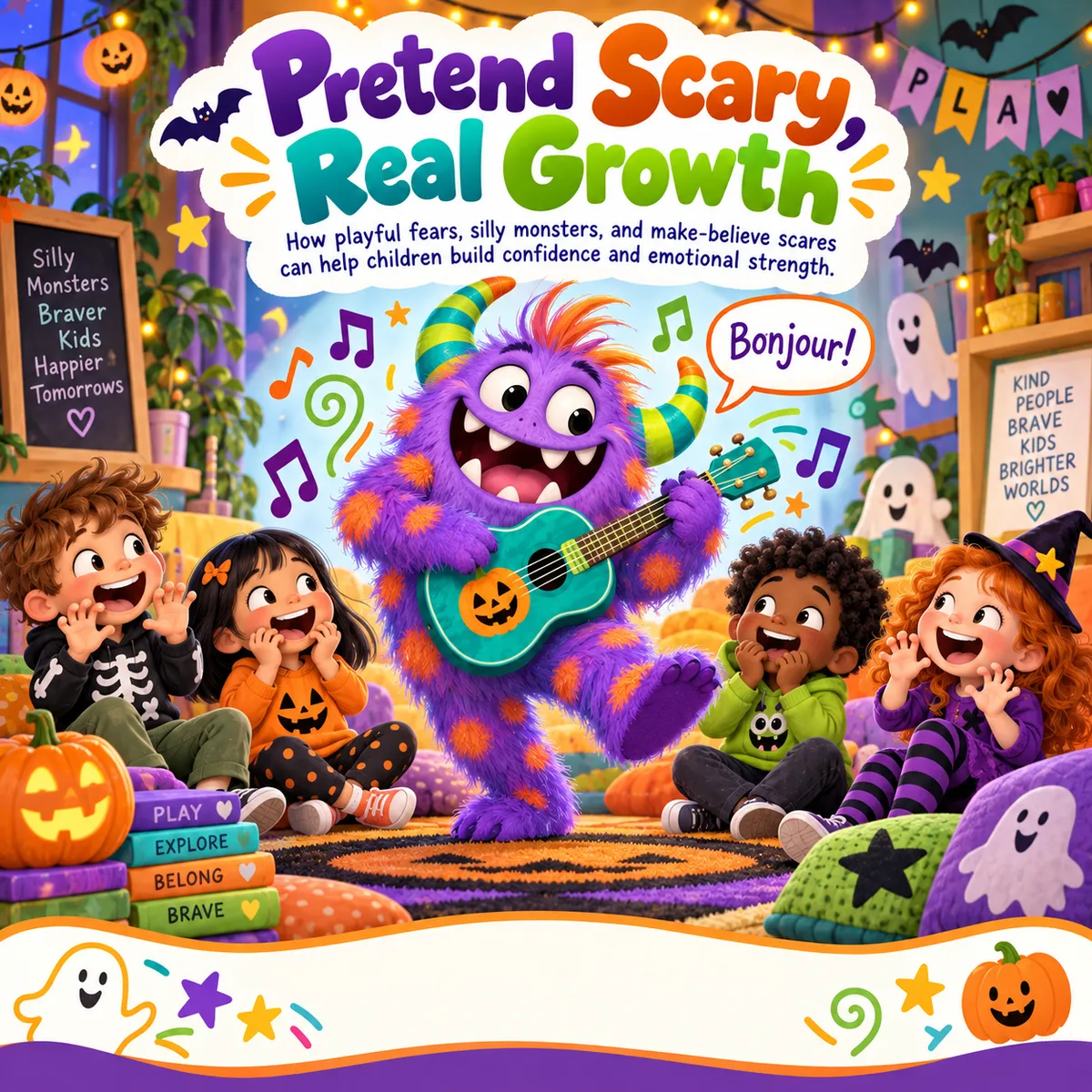
We can turn the scary monster into a dancing monster wearing imaginary purple socks.
Suddenly, something that felt a little frightening becomes ridiculous.
That shift matters.
It shows children that feelings can change. Something can begin as uncertain and become funny. A surprising sound can become familiar once we hear it again. Something new can feel less intimidating after we explore it.
That is a pretty big lesson hiding inside a very silly monster song.
Even Monsters Can Learn French and Spanish
Of course, once we've invented our musical monsters, I can't resist inviting a little language into the adventure.
Music makes new words much easier for children to approach because they are already playing with sound.
We might count our monster's footsteps in French, sing a simple Spanish phrase, or discover how familiar Halloween words sound in another language.
Suddenly, practicing a new word is not an assignment.
It is part of the story.
Maybe our monster takes trois enormous steps.
Perhaps our imaginary creature says hola before joining the band.
Children are often remarkably willing to experiment with unfamiliar sounds when those sounds belong to a song, rhythm, or game. They are not stopping to worry about whether their pronunciation is perfect. They are listening, copying, laughing, and trying again.
That playful willingness is exactly what makes music such a natural doorway into language learning.
The Instruments Become Characters Too
One of my favorite things about using real instruments with children is discovering how quickly they give those instruments personalities.
A drum does not have to be "just a drum."
Today, it might be the footsteps of a giant.
A shaker can become the sound of autumn leaves.
A tambourine might be a rattling skeleton.
My guitar can turn a simple story into an entire musical adventure.
When children start deciding what an instrument represents, they are making creative choices. They are listening carefully to the qualities of each sound and connecting those sounds with images, characters, and emotions.
That is imagination at work.
It is also storytelling, problem-solving, listening, movement, language, and collaboration, all happening while everyone is busy deciding exactly how a skeleton should dance.
For the record, children have some very strong opinions about this.
Not Every Child Finds the Same Things Scary
There is another important part of exploring spooky sounds with children.
Every child responds differently.
One child might adore the enormous BOOM of a drum. Another might prefer the soft sound of bells. One child wants to be the monster. Another would much rather be the butterfly who lives nowhere near the monster, thank you very much.
We do not need every child to experience music in the same way.
Instead, we can follow their cues.
If something feels too intense, we soften it. If a child would rather listen before joining in, they can listen. If the spooky song needs to become a silly song, we let it change.
The goal is never to frighten children.
The goal is to give them room to explore different sounds and feelings while knowing they have choices within the experience.
That sense of choice can be incredibly powerful.
Sometimes the Best Way Through a Feeling Is to Play With It
October will bring plenty of pumpkins, costumes, ghosts, candy, and very enthusiastic discussions about who is going to be what for Halloween.
But tucked inside all that seasonal fun is a wonderful opportunity.
We can help children become curious about feelings instead of immediately labeling some emotions as "good" and others as "bad."
What does nervous sound like?
What does feeling excited sound like?
Can something sound mysterious without being scary?
Can we turn a worried rhythm into a brave one?
Music allows children to explore those questions without requiring a perfect answer.
We can drum them.
Sing them.
Dance them.
Whisper them.
And sometimes laugh at them.
Because childhood should include space for big feelings, big imaginations, and very big monster footsteps.
And if that monster happens to know a few words in French or Spanish by the end of the song, even better.